A Meditation on Israel/Palestine/Gaza for the High Holy Days
Note: Read the text BELOW then listen to the audio linked ABOVE.
In spring of 2025, Rabbi Toba Spitzer convened the artists of Dorshei Tzedek, my congregation in West Newton, MA, for a few hours of text study. We were there at her invitation to make art for our congregation’s High Holy Days, this time on the theme of the shofar. As we gathered, I wondered to myself: How can we make Jewish art in a time of Jewish genocide? My answer arrived slowly: a text-audio piece entitled “One Hundred Blasts, Two Women, A Single Cry of Grief: A Meditation on Israel/Palestine/Gaza for the High Holy Days.”
The content of this piece emerged from the juxtaposition and apparent contradiction of two rabbinic commentaries we read that afternoon and the stunning nature of one of them in particular. The first text describes Sarah watching as Abraham takes Isaac off to sacrifice him and tells how, hearing that Abraham was about to slaughter their son, “[Sarah] screamed six calls against six tekiot.” The second commentary tells how Sisera’s mother, upon hearing of her son’s death, sighed, cried, and gasped “and therefore the teru’ah should sound like shevarim, a gasping sound […or…] broken like uncontrollable crying.” Who was Sisera? A bloodthirsty Canaanite commander portrayed in the Book of Judges as gleefully slaughtering Israelite men, raping Israelite women, and pillaging Israelite villages.
In the midst of what B’Tselem, Israel’s main human rights organization, would call just a few months later “Our Genocide,” the ancient understanding that grief of our people and the grief of our enemies are one and the same (or two sides of the same coin) seemed to me to be speaking directly to us in 5786 from across the millennia. That the shofar blasts at the center of our holiest days of the year might be understood by our ancient forebears to be at once the cries of grief of our first Matriarch and of the mother of one of our most merciless foes floored me. (It also reminded me of how on Passover we spatter drops of our own wine (blood?) in memory of the Egyptian soldiers who drowned when the Red Sea was closed again.)
What, I wondered, might it sound like to actually hear that equivalence on the holiest of Jewish days: the shofar blasts as both mothers’ cries of grief? I started to imagine recording the voices of two different women—Sarah and Sisera’s mother—sighing, sobbing, gasping, crying out—and then somehow combining them with the blasts of the shofar. But how? First, however, came the why. As I thought about the coexistence of these two, completely “opposite” understandings in Jewish thought of what the shofar blasts on the Rosh Hashanah represent, I realized that not only must this piece represent both possibilities but that key to creating this experience was that the listener wouldn’t know which voice was whose.
My piece would offer an experience suggesting that the grieving of Palestinian and Jewish Israeli women—even the mothers of men who had slaughtered, raped, and pillaged residents in southern Israel on October 7 and the mothers of men who had slaughtered, raped, and pillaged Palestinians in Gaza and the West Bank following October 7—equally merit and deserve our compassion and identification. On the holiest days of our year, we evoke and remember both women, their common, human grief embodied in our most essential rituals.
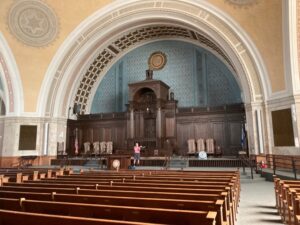
I knew what I wanted my piece to do, but I had no idea what the final product would sound like or how I was going to make it. I did know, however, that this piece would require recording the shofar and two voices in an acoustically grand space, fitting for the monumentality of the moment. Thanks to Rabbi Audrey Marcus Berkman, Senior Rabbi of Temple Ohabei Shalom in Brookline, MA, and her generous temple staff, I was able to arrange four recording sessions in the temple’s main sanctuary, built in 1927—a glorious space that I consider to be the Jewish Symphony Hall of the Boston area. First, I recorded Ezra, who fortuitously brought along his stubby, higher-pitched shofar, a bar mitzvah present that perfectly complemented the deep, long shofar I’d borrowed from another member of our congregation. We hadn’t planned it that way, but it was perfect: two shofars for two voices, one lower, one higher.
Jamie, a baritone from Dorshei Tzedek, and Thomika, a soprano and a former member of an Orthodox Jewish women’s theater, joined me at the second session. I explained the concept of the piece and then played some of the recordings of Ezra sounding the tekiah, shevarim, teruah, and tekiah gedolah blasts. Reaching deep down, they each found her own ways to echo and embody the sound of the shofar as sighs, gasps, wails, and cries. As we proceeded, the recording session grew increasingly emotional, and by the end was a powerful, even cathartic, experience.
Now I had the recordings I needed, and for the first time, I could tell the piece was going to work. But how? It took two more recording sessions, shofar and voice, and then a month of editing. The editing was my performance. Using an audio editing software, I started combining the blasts of the shofar with the two women’s voices, as well as my own voice calling the blasts. As I learned the software, I found myself following my intuition as I combined the four elements, at times letting the two women’s voices echo the shofar blasts, at other times accompany or respond to them, and a few times even replace them. Slowly, the piece came together: a complex and shifting conversation between the blasts of the shofar and the two women’s voices.
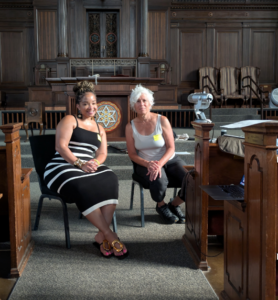
Thomika and Jamie, the wailing women
Ezra playing the shofar in the sanctuary of Temple Ohabei Shalom
Meanwhile, my techie friend Mike and I designed the physical form the piece would take: a box with a soundboard containing the finished audio file, which, when the listener pushed a button, the audio would play through a set of wireless headphones. I considered having several sets of headphones so many people could listen to the piece at once, but in the end, I decided that I wanted the piece to be experienced privately, one person at a time, a personal experience of a sacred relationship: the millennial connection between the shofar blasts and all women’s grief. The instructions: Read the accompanying text to the audio piece, put on the headphones, and then press the button.
Now it’s your turn! Here’sthe text. After you’ve read it, return to this page and play the audio by clicking on the arrow at the top of this page.
You can also find additional readings about the symbolism of the shofar blasts connected with Sisera’s mother here.
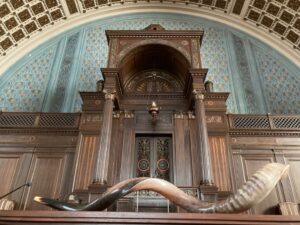
One of the shofars used in this piece on the bima in the main sanctuary of Temple Ohabei Shalom.
All photography on this page is by the author, Mark Schafer.
Mark Schaferis an Ashkenazi Jewish artist, literary translator, and Spanish instructor. As an artist, he creates visual art (collage, dream maps), sound art (audio pieces), spatial art (sculptures), and art installations (collaborations with trees). As a translator, he writes poetry and fiction in English that was originally written in Spanish. As a Spanish teacher, he opens a door to the Spanish-speaking world for his students and walks with them through it. Mark lives with his family in Roxbury, MA, the unceded territory of the Massachusett people.
All content shared her is copyrighted by the author.