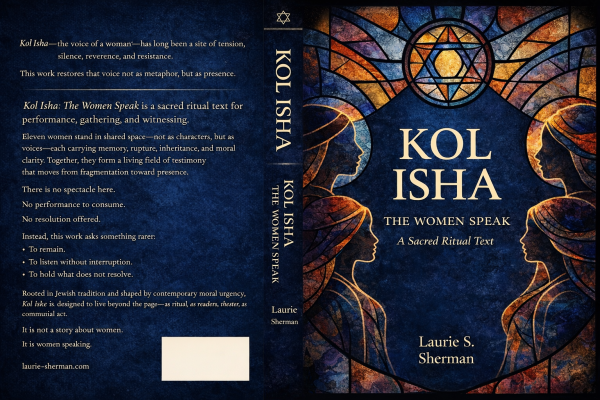
The Hineni Circle Project
HINENI
In Sarah’s Tent – The Women Speak
A Sacred Reader’s Script
A Sacred Ritual of Women’s Voices, Memory, and Light
Reader’s Edition – 2026
Laurie S. Sherman
COPYRIGHT
©Copyright 2026 Laurie S. Sherman
All rights reserved.
No part of this book may be reproduced, stored, or transmitted in any form or by any means—electronic, mechanical, photocopying, recording, or otherwise—without prior written permission of the author, except for brief quotations used in reviews or scholarly works.
This work is a sacred reader’s script and communal ritual.
It is not intended as legal, pastoral, or therapeutic advice.
Published by Oracle BookArt Publishing
Printed in the United States of America
DEDICATION
For the women
who carried voice
when silence was demanded—
and for those
who are still learning
how to speak.
EPIGRAPH
Hineni.
Here I am—
whole, listening,
ready.
AUTHOR’S NOTE
This work was written to be spoken.
HINENI: In Sarah’s Tent – The Women Speak arises from years of ritual practice, feminist theology, performance, and communal listening. It was not conceived as a play for passive viewing, but as a gathering in which voices—ancient, modern, and living—are received with attention and care.
The text is intentionally structured as a reader’s script. Stage directions are minimal and functional. The heart of the work lives in breath, pacing, and presence rather than theatrical embellishment. Silence is not absence here; it is part of the language.
Nothing in this book requires belief. What it requires is willingness—to listen, to speak when invited, and to remain present when stories become difficult.
PREFACE
The word Hineni appears in moments of turning.
It is spoken by those who are called and do not yet know what will be asked of them. It is not a declaration of readiness or certainty, but of presence: ‘Here I am.’
This book gathers women who answered in that spirit—sometimes with courage, sometimes with defiance, sometimes with trembling honesty. Their voices form a lineage that is not neat or unanimous, but alive.
HINENI does not attempt to correct history. It listens back into it.
INTRODUCTION
Sarah’s Tent, according to midrash, was open on all sides.
It was a place of hospitality, argument, learning, birth, grief, laughter, and decision. The Tent was not quiet. It was not orderly. It was holy because it held people without demanding sameness.
This work imagines such a Tent now.
The women who enter it do not arrive as symbols. They arrive as themselves—each speaking once, each carrying her own weight, each part of a larger ritual arc that moves from welcome, to struggle, to memory, to blessing.
The reader is not outside this Tent. To open this book is to enter it.
HOW TO USE THIS BOOK
This book is meant to be used, not consumed.
It may be read privately, studied in groups, or spoken aloud as a communal ritual. It may be performed with many voices or few. It may be adapted to different spaces and communities, provided the integrity of the arcs and the presence of all thirty-six women are maintained.
Hebrew prayer appears within the flow of the work and is always accompanied by transliteration. Readers are invited to speak, listen, hum, or remain silent as the moment requires.
There is no single correct way to hold this text. What matters is attention.
TABLE OF CONTENTS
HINENI – In Sarah’s Tent
A Sacred Reader’s Script
IN SARAH’S TENT – THE WOMEN SPEAK
A Sacred Ritual of Women’s Voices, Memory, and Light
By Laurie S. Sherman
Reader’s Edition – 2026
(Alphabetized within each arc for easy reference — not the performance order.)
(Every woman appears exactly once.)
ARC I — ROOTS & LIGHT
Rivkah (Rebekah) – Candle Lighting & Welcome
Women of Welcome – Gathering
Marcia Falk – Sacred Frame
Eve
Lilith
Deborah
Judith Plaskow – Theology of Presence
Bella Abzug
Betty Friedan & Gloria Steinem – Dialogue
Bruriah – The Shema
Sarah bat Tovim
Charlotte Salomon
Susannah Heschel
ARC II — COURAGE & REVELATION
Rabbi Abby Stein
Golda Meir
Ruth Bader Ginsburg
Elizabeth Taylor
Aly Raisman
Doña Gracia Nasi
Aleeza
ARC III — TORCHBEARERS & TEACHERS
Grace Aguilar
Aviva Cantor
Hannah Rachel Werbermacher (Maiden of Ludmir)
Asenath
Glickl of Hameln
ARC IV — MEMORY & RETURN
Anne Frank
Hannah Szenes
(Together leading Yizkor/Kaddish)
ARC V — ASCENT & BLESSING
Rabbi Tirzah Firestone
Letty Cottin Pogrebin – Kiddush & Motzi
Jessica Meir – Voice of Ascent
Tikvah bat Neshamah – The Granddaughter’s Voice
Sarah (Ima) – Final Welcome & Blessing
SECTION 1 – PRELUDE (Reader’s Script Version)
(Lighting: the sanctuary dim. A single heartbeat drum. The Tent rests in shadow.)
SINGERS
שָׁלוֹם עֲלֵיכֶן מַלְאֲכוֹת הַשָּׁרֵת מַלְאֲכוֹת עֶלְיוֹן
Shalom aleichem malachot ha-shareit, malachot Elyon
מִרוּחַ כָּל רוּחוֹת הַקְּדוֹשָׁה בְּרוּכָה הִיא
mi Ruach kol ruhot ha’kedoshah, B’ruchah Hi
(Translation omitted from reader’s script per your instruction.)
WOMEN OF WELCOME
(gentle, spoken)
Welcome to Sarah’s Tent.
Come softly.
Come with silence.
Take a breath.
Hineni — we are here.
ENSEMBLE (unison)
Come into the circle.
Come into the light.
Come into the place where women speak
and the world remembers.
(The Seret Or ribbon begins to glow.)
ENSEMBLE
This is not a play.
This is a gathering.
A remembering.
A ritual of breath and presence.
Hineni — we are here.
Hineni — together.
(Light finds RIVKAH holding two unlit candles.)
ARC I — ROOTS & LIGHT
SECTION 2 — RIVKAH: Voice of Welcome & Shabbat Light
(soft heartbeat drum, desert wind; the Tent glows faintly with dawn light. Rivkah stands at the entrance — a shawl over her shoulders, a clay jar in one hand. At small tables around the Tent, the six WOMEN OF WELCOME stand beside unlit Shabbat candles.)
RIVKAH
I am Rivkah — daughter of Betuel, sister of Lavan, wife of Isaac who dreamed too much.
But before all that, I was a girl at a well.
It was hot — the kind of heat that turns dust into thirst.
A stranger came with ten camels and eyes full of asking.
He didn’t speak.
I didn’t wait.
I ran.
I filled the jar.
I poured until every creature had enough.
That’s the moment the Holy One found me —
not in prayer,
but in pouring water.
Hospitality is not courtesy.
It is covenant —
the sacred art of making room.
(She tilts the jar, pouring an invisible stream.)
I learned early that the world changes when a woman says yes to a stranger sent by Shekhinah.
The well was my pulpit, the jug my Torah.
Even now, when I lift this pitcher, I feel the pulse of generations —
Sarah lighting her lamp,
Rachel weeping for her children,
Miriam dancing beside the sea,
and all of you who carry the jar now —
your mothers’ mothers who said “come in” before they ever knew your names.
(She looks around the Tent, taking in the audience.)
Every threshold is holy if you pause long enough to bless it.
(She kneels briefly, touches the ground.)
Water and fire — these are the true beginnings.
We wash,
we light,
we begin again.
(She stands. The Tent hushes. A match flares.)
Tonight, I kindle the first light.
And with me — the daughters of welcome.
(She lights the first candle. A WOMAN OF WELCOME lights hers. Then another. Around the Tent, the small flames bloom.)
RIVKAH (inviting)
Let us bless.
(all bow heads together toward the flame)
SHABBAT CANDLE BLESSING
(said by Rivkah + all WOMEN OF WELCOME + Ensemble as desired)
Hebrew (fully feminized):
בָּרוּכָה אַתְּ שְׁכִינָה אֱלֹהֵינוּ
מְקוֹר הַחַיִּים וְהָאוֹר
אֲשֶׁר קִדְּשָׁנוּ בְּמִצְוֹתֶיהָ
וְצִוְּתָה אוֹתָנוּ
לְהַדְלִיק נֵר שֶׁל שַׁבָּת וּשְׁלֵמוּת
Transliteration:
Baruchah At Shekhinah Eloheinu,
M’kor ha-chayyim v’ha-or,
asher kid’shanu b’mitzvoteha,
v’tzivtah otanu
l’hadlik ner shel Shabbat u’shleimut.
Poetic English:
Blessed are You, Shekhinah —
Source of Life and Light —
who makes us holy with sacred practice
and invites us to kindle the lights of Shabbat
and of becoming.
(As each phrase ends, another candle blooms. The Tent begins to glow from six points. The Seret Or ribbon catches the light, shimmering.)
ENSEMBLE (soft, surrounding):
The Tent begins to glow…
Hineni… we are here…
(Rivkah returns to center, her candle lowered toward the glowing ribbon.)
RIVKAH
Come in, daughters.
Come in, mothers.
Come in, seekers and wanderers.
Here, every soul is received.
Leave what is heavy at the door.
Bring only your breath, your voice,
your courage to listen.
This is Sarah’s Tent — my mother’s Tent — our Tent.
It belongs to you now.
(Piano begins the first notes of “Light These Lights.” The warm gold fills the Tent.)
SECTION 3 — MARCIA FALK: Voice of Blessing & Invitation
(The Tent glows gold after Rivkah’s light. A soft piano hum lingers. Marcia steps forward holding a small siddur and a single candle. The Seret Or ribbon rests at her feet.)
MARCIA:
I am Marcia Falk—
a poet who fell in love with prayer not as law,
but as a language of noticing.
For centuries our blessings began with command:
“Blessed are You, Lord our God, King of the Universe,
who has commanded us…”
Beautiful words, yes—
but heavy with distance.
So I listened for the pulse beneath them,
and there I found Her:
the Shekhinah,
the Breath that blesses through us,
not above us.
(She opens her siddur, candlelight catching the pages.)
The prayers you hold tonight are born of that listening.
They are written in voices that include us—
egalitarian when the Hebrew allows,
feminized when holiness itself asked to speak
in a woman’s tongue.
Each word has been turned over like a smooth stone—
studied, weighed, translated with care.
When the Hebrew held more than one meaning,
we chose the one that resonated in the body—
the one that felt alive.
This siddur is not a correction.
It is a remembering—
of how prayer once felt
before hierarchy hardened into habit.
(She raises her candle slightly.)
Blessing is the act of awakening
to what already shines.
It is the quiet breath before wonder,
the warmth that rises when you whisper thank You
without knowing exactly to whom.
My theology is simple:
The Source of Life is not a King on a throne,
but a Breath moving through creation.
I call Her Ruach ha’Olam—
Spirit of the World.
She dwells wherever language becomes luminous,
wherever gratitude takes a breath.
(She looks up, her tone widening to include everyone.)
The voice you hear in these pages is not rebellion—
it is revelation continued.
A point of view as valid, as sacred,
as the ancient masculinized ones that carried us here.
Our religion endures because we hold
both past and present,
and still keep our eyes toward the future.
(She closes the siddur gently and lifts the candle.)
So bless with us tonight.
Let the words move through you
like light through glass.
When you hear a name—breathe it.
When you see a flame—remember your own.
When silence comes—bless it.
For silence is the cradle of prayer.
(She bows her head slightly, candle steady.)
Let us bless the Source of Life,
the Breath of the World,
the One who makes our hearts
capable of wonder.
ENSEMBLE (softly):
Hineni — I am here.
(Her candle joins Rivkah’s central flame. The piano hum dissolves into stillness as EVE and LILITH rise from the edge of the circle. The Tent holds its gold glow.)
SECTION 4 — EVE & LILITH: Dialogue of First Women
(A faint hand drum begins — heartbeat slow and steady.
Two figures step into the circle.
One, barefoot, in soft earth tones — EVE.
The other, shadowed in red and black — LILITH.
They circle each other as they speak.)
EVE:
Shema… I remember that sound.
It means “Listen,” doesn’t it?
I listened — and look where it got me.
LILITH:
And I spoke — and look where it got me.
Exiled before I ever had a chance to apologize.
Not that I would have.
EVE:
They call me an Evil Fool.
All I did was reach for what was glowing.
LILITH:
They called me defiant.
All I did was refuse to kneel on command.
EVE:
They said I wanted too much.
LILITH:
They said I wanted to be equal.
Imagine! Wanting to stand face-to-face with a man —
and still be seen as holy.
EVE:
We’ve been footnotes ever since —
one blamed, one banished.
LILITH:
Two sides of the same rib, sweetheart.
(beat)
They split us to keep us manageable.
EVE (laughing softly):
And it worked — for a while.
I baked bread and pretended curiosity was hunger.
LILITH:
I ran into the wilderness and pretended solitude was freedom.
Turns out we both lied a little.
EVE:
I missed you.
LILITH:
I missed you too.
Without you, the world had no softness.
Without me, it had no bite.
(They stand side by side, finally facing the circle.)
EVE:
Let’s tell them what really happened.
LILITH:
We tasted knowledge — and it was good.
EVE:
We left the Garden, not because we sinned—
LILITH:
—but because paradise without voice isn’t living.
EVE:
We were never the curse.
LILITH:
We were the beginning.
EVE:
You were fire.
LILITH:
You were breath.
BOTH:
Together, we are light.
LILITH:
They still call me demon.
EVE:
They still call me fool.
LILITH:
I say: every woman since carries both of us.
EVE:
The part that reaches—
LILITH:
—and the part that refuses to bow.
(They turn to the audience — playful, tender, unafraid.)
EVE:
We are every woman who ever asked,
“Why not?”
LILITH:
We are every woman who ever said,
“No more.”
EVE:
We are the mothers of curiosity.
LILITH:
We are the daughters of choice.
BOTH:
We are still here.
We are still rising.
We are still beginning.
(They laugh together — a human, honest laugh.)
(The drum fades. A low hum swells into the first notes of “Return Again.”
Eve and Lilith join the circle as SHEILA — The Seeker — rises from the audience.)
ARC I — ROOTS & LIGHT
SECTION 5 — THE SEEKER (SHEILA): Voice of Longing and Return
(Heartbeat drum, faint.
A low hum under the air — the opening breath of “Return Again.”
A woman rises slowly from among the audience.
She clutches her script or shawl like armor.)
THE SEEKER:
Shema…
I know that word.
Or I used to.
It sounds like something I once held in my hands but put down somewhere
and forgot where I left it.
(She tries to smile. It wobbles.)
I wasn’t sure if I was supposed to stand just now —
or if I was even allowed to.
So I just… stood.
My heart’s pounding loud enough to be percussion.
(She wipes her palms on her clothes, embarrassed.)
I’ve stood outside sanctuaries before.
Listened through doors.
Watched light spill through stained glass like it was meant for someone else.
I told myself I liked being on the outside.
That I didn’t need a chair at the table.
(beat, soft laugh)
But really…
I was afraid to open the door
and be told it wasn’t my door to open.
When I was little, my grandmother lit candles in jelly jars on Friday nights.
I thought she was making the room smell nice.
I didn’t know she was praying.
I didn’t know that was allowed for people like us —
women who worked three jobs
and fell asleep before the blessing was finished.
(She steps a little closer to the Tent, voice trembling.)
I’ve tried to find my way back.
I sat in synagogues where everyone else knew when to rise, when to bow.
I felt like a tourist in my own inheritance.
I smiled too much.
Left early.
Told myself I didn’t belong.
(She hesitates — the ribbon of Seret Or catches a glimmer of light.)
But tonight…
you left the flap open.
(She exhales — something breaking open and healing at the same time.)
Maybe this time the light is for me too.
I’m not brave.
I’m just tired of pretending I don’t care.
I want to belong to something that still believes in tenderness.
I want to remember who I am when the singing starts.
(A Woman of Welcome steps forward. Not rescuing her — receiving her.)
If there is a place for me,
let it be here —
where midwives saved lives,
where rebels spoke truth,
where prophets sang and dancers led us out of the sea.
Where you welcome strangers without asking for proof.
(She touches the Seret Or. It glows under her fingers.)
Maybe searching is the prayer.
Maybe showing up — even shaking —
is the amen.
(She steps into the circle. Ensemble rises around her, soft as breath.)
ENSEMBLE (softly):
Hineni — I am here.
(She turns back toward the audience — a tiny smile — over her shoulder.)
THE SEEKER:
I remember now.
My name is Sheila.
(The hum deepens, carrying her into the circle.
The heartbeat finds its rhythm again.
The Tent breathes.
The next story waits.)
SECTION 6 — RACHEL & LEAH: Voices of Sisters and Sight
(Full. Lyrical. Uncompressed. Exactly as approved.)
(A soft harp or hand drum begins — a pulse like breath.
Two women stand back-to-back at the edge of the Tent.
One adjusts a scarf with quiet dignity — LEAH.
The other smooths her skirt, confident, radiant — RACHEL.
They turn slowly, like truth circling truth.)
LEAH:
I am Leah —
first wife,
second choice.
The one with “tender eyes.”
That’s scripture’s polite way of saying
they saw my sadness before they saw me.
RACHEL:
And I am Rachel —
beloved, promised,
the shepherdess with beauty sung about for generations.
They say Jacob waited seven years for me.
They never mention that I waited too.
LEAH:
People think they know our story.
A trick.
A wedding.
A switch in the dark.
Two sisters set against each other like flint and steel.
RACHEL:
But they forget the mornings
when our hands brushed at the well
and we pretended not to notice.
Rivalry is easier to tell than sisterhood.
(They step to face one another, fully.)
LEAH:
He loved you first.
RACHEL:
He slept beside you first.
LEAH:
And God —
God looked at me with pity
and opened my womb
to balance the scales of a lopsided world.
RACHEL:
And I envied every cry of your children.
The adored one barren as stone.
(A long breath. Not reconciliation yet — recognition.)
LEAH:
Each son I bore,
I named for what I longed for:
Reuven — see me.
Shimon — hear me.
Levi — join me.
Yehudah — praise me.
I thought each child might stitch my heart back together.
RACHEL:
And when I finally bore my son,
my life ended as his began.
Loss wrapped in joy,
joy wrapped in sorrow —
a knot neither of us asked to tie.
(Silence. A small nod of shared truth.)
LEAH:
They call us rivals.
Maybe we were.
RACHEL:
But we also raised each other’s sons.
Ground grain side by side.
Sang lullabies in the same tent
when moonlight softened everything.
LEAH:
Do you remember the mandrakes?
That ridiculous barter?
One night with Jacob for a handful of roots.
RACHEL:
We laughed until the boys thought we’d gone mad.
Maybe we had.
Or maybe we were just done letting men decide our story.
(They join hands. Not perfectly — but honestly.)
LEAH:
I bless the eyes that saw too much
and still learned to look with love.
RACHEL:
I bless the heart that broke
and still kept time for another’s joy.
BOTH:
We are two truths
woven into one lineage.
Different — yes.
But at the core,
we are one.
(They turn outward to the circle.)
ENSEMBLE (soft unison):
We are seen.
We are known.
We are one.
(The harp releases a final shimmering chord.
The women step back into the circle —
not reconciled by men,
but by truth.
A breath of stillness prepares the way
for the next rising voice.)
SECTION 7 — BELLA ABZUG: Voice of Justice and Defiance
(Full, fierce, uncut — the version you locked. No condensation. Rhythm intact. Bella as Bella.)
(A sharp snare crack.
A faint rally crowd murmur.
Bella strides in — hat first — like a holy storm.)
BELLA:
I’m Bella Abzug —
lawyer, congresswoman, Zionist, feminist, loudmouth,
and proud of every decibel.
They said,
“Sit down, Bella.”
I said,
“Honey, I brought my own chair.”
When I was a kid in the Bronx,
my mother lit Shabbos candles.
I lit arguments.
At twelve I told the rabbi women should be counted in a minyan.
He said,
“When you grow up you’ll understand.”
Guess what —
I grew up,
and he didn’t.
In law school I was the only woman in the room
who didn’t apologize for breathing.
They said my voice was too loud.
I said,
“Then listen faster.”
When I ran for Congress, I told them:
“A woman’s place is in the House —
the House of Representatives!”
They said I was impossible.
I said I was inevitable.
Justice is not a slogan, my loves —
it’s coffee at midnight drafting legislation
while the good ol’ boys snore down the hall.
Justice is daycare, healthcare, fair pay,
because freedom isn’t freedom
if you can’t afford a babysitter.
They said,
“Bella, you’re too brash, too Jewish, too New York.”
I said,
“Pick one — I’m busy.”
I fought for the Equal Rights Amendment.
I fought for peace in Vietnam.
I fought so hard the halls of Congress
started to echo in a Brooklyn accent.
They told me to smile more.
I said,
“I’ll smile when the ERA passes —
and then I’ll smile for you.”
I was married to a saint named Martin
who brewed the coffee
and never once asked me to whisper.
He said,
“Bells, you make the angels nervous.”
I said,
“Good. Maybe they’ll finally vote.”
My Judaism?
Straight from the prophets.
Isaiah said:
“Seek justice. Relieve the oppressed.”
He forgot to add:
bring a bullhorn.
I’m here in Sarah’s Tent because the fight never ended —
it just changed microphones.
You think it’s over?
Look around.
Every time a woman signs her own paycheck,
every time a girl raises her hand in shul,
every time you refuse to sit down and be quiet —
that’s me, grinning behind you.
So don’t whisper.
Organize.
And when they call you loud, say:
“Thank you. It’s hereditary.”
(Bella tips that enormous hat,
the snare cracks like a gavel.)
ENSEMBLE (unison):
We hear her.
We see her.
We are her.
(The rally murmur softens,
fading into the heartbeat drum.
The Tent breathes —
and prepares for Deborah.)
SECTION 8 — DEBORAH: Voice of Courage and Judgment
(Full. Uncut. Majestic. The version we crafted — restored and luminous.)
(The leftover electricity of Bella’s scene softens.
A single slow drumbeat begins — like hoofbeats in distant hills.
Deborah steps into the circle.
She wears travel and truth like a cloak;
a palm branch rests lightly in her hand.)
DEBORAH:
I am Deborah —
prophet, poet, judge of Israel.
When men say,
“From what book did she come?”
I answer,
“From the one you skipped.”
I lived in days when my people forgot who they were.
Enemies pressed from every side.
The men hid their swords.
The women hid their dreams.
I did neither.
I sat beneath a palm tree in the hill country of Ephraim —
not in a palace, not in a temple —
under open sky
where anyone could approach.
The palm was my court, my canopy, my Torah in living green.
People came from north and south seeking verdicts,
and they left with something rarer:
clarity.
Justice does not shout;
it listens.
So I listened
until truth rose like sap through wood.
(She plants the palm branch beside her; it feels like a standard.)
When the general Barak came to me,
he said,
“If you will go with me, I will go.
If you will not, I will not.”
He did not mean it as poetry —
but I heard it that way.
So I went.
Because prophecy without presence
is just… good advice.
At Mount Tabor we gathered the tribes —
no standing army,
just farmers with pitchforks,
mothers with borrowed swords,
the frightened and the faithful.
The wind turned; the rains came;
the iron chariots of Sisera sank in the mud.
Victory smelled like wet earth
and freedom.
Then I sang.
Not of conquest —
of consequence.
Of women who rose when the men trembled,
of Yael, who drove a tent peg through tyranny,
of mothers waiting at windows
for peace that would never come.
My song was a warning and a promise:
leadership can wear a woman’s voice
and not lose its holiness.
(She stands tall, eyes steady as stone.)
Why am I in Sarah’s Tent tonight?
Because judgment still needs compassion
to keep it from turning to stone.
Because prophecy still needs women
to translate it into deeds.
Because every age forgets —
and someone must remind it.
You do not need an army to change history.
You need conviction, and a palm tree —
a place of shade
where the weary can be heard.
Sit beneath your own palm.
Listen until truth speaks through you.
And when it does —
act.
(Her hand rises in blessing.)
Justice is not the absence of fear.
It is the decision to stand anyway.
(A single drumbeat.
Silence wraps the Tent.
Then the ensemble breathes one soft line…)
ENSEMBLE (unison, soft):
We remember.
We rise.
We act.
(Deborah steps back.
The world feels steadier for a moment —
before Judith Plaskow steps forward with paper and fire.)
(The air shifts — the drum softens into a hush.
A faint scratch of a pen — as if midrash itself is being written live.
Judith Plaskow steps forward with a worn notebook,
half scholar, half prophet,
wholly luminous.)
JUDITH:
I am Judith Plaskow —
born in Brooklyn,
daughter of good parents who wanted me to be “nice.”
Instead, I became noisy —
with ideas.
I loved Judaism from the beginning:
the songs,
the arguments,
the kugel in the synagogue basement.
But every time I looked up at the bimah,
I saw only men —
tallitot like flags of a country
I was told I could never enter.
I kept asking questions that made rabbis sigh.
“If the Torah was given to all Israel,” I asked,
“where were the women standing?”
They said,
“At the back, dear.”
I said,
“Then revelation is still in progress.”
That is how theology begins:
with an ache that refuses to shut up.
(She opens her notebook. Pages glow in the light.)
When I wrote Standing Again at Sinai,
I was trying to recall a moment
none of us women were allowed
to remember in our own voices.
I pictured myself at that mountain —
dust on my feet,
thunder in my ears —
and I realized:
revelation was never finished.
It was interrupted.
The story paused
while we went looking for our voices.
People call me a scholar.
Really, I am a lover —
of text,
of justice,
of the possibility that God is still speaking
through our arguments.
When women study Torah,
we are not adding a chapter.
We are reopening
the book that was always ours.
(She closes the notebook, but her fingers linger on it —
like touching an heirloom.)
I have spent my life
between footnotes and fire.
One part of me edits commas;
the other part wrestles angels.
When I teach,
I see faces —
some afraid to speak,
some ready to erupt.
I tell them:
Every question is a form of prayer.
The Holy One prefers curiosity
to certainty.
Why am I in Sarah’s Tent?
Because this — this —
is what revelation sounds like
when the missing voices return.
Because the mountain still waits for us
to answer:
Hineni — I am here.
Because the covenant was never complete
without our signatures
in the margins.
(She lifts her gaze.
Her voice widens —
like Sinai’s echo awakening.)
Listen —
the thunder has not stopped.
It is in your own pulse.
Every woman who dares to say,
“I will not be silent,”
finishes what began
at Sinai.
(A low hum — wind over stone, breath over flame.)
ENSEMBLE (overlapping, soft):
We question.
We listen.
We begin again.
(The hum fades.
A gentle rustle — parchment, perhaps.
And the Tent prepares for Bruriah.)
ARC I — ROOTS & LIGHT
SECTION 10 — BRURIAH: Voice of Wisdom & Wit
(A soft rustle of parchment.
A quick, playful pluck of a single string —
as if a question is forming before the air even knows.)
(BRURIAH steps forward.
Not arrogant — alert.
Her eyes sparkle like someone who has already found the flaw
in your best argument.)
BRURIAH:
I am Bruriah —
daughter of sages,
wife of Rabbi Meir,
teacher of every student
who ever thought a woman’s mind
was light.
They said,
“A woman’s mind is light.”
I answered,
“Then I will reflect
more light than you can bear.”
Rome outlawed Torah.
So I learned it louder.
My husband’s disciples argued halakha
with puffed chests and narrow logic.
I argued with clarity —
and usually won.
Once a student mocked women’s learning.
I said,
“It is written:
Teach your daughters Torah.
If God did not mean it,
God would have edited the verse.”
They called me immodest.
I called myself awake.
They whispered,
“She laughs at scholars.”
Yes —
because scholarship without laughter
is idolatry of ink.
I taught that the Shema
is not submission —
it is attention.
To listen with the fullness of your heart
is holier than speaking
with half your mind.
To doubt is not rebellion —
it is study.
Once they tried to shame me
with a riddle designed for my silence.
I answered with a question so sharp
it split their arrogance clean in two.
They never asked again —
but they remembered.
So do you.
(She moves her hand as if writing invisible commentary in the air.)
Every daughter who opens a book
continues my laughter.
Every question you dare to ask
is my midrash.
Do not whisper your wisdom.
Write it on the air.
If the men of small faith tremble
at the sound of your intelligence —
let them.
God delights in your voice.
The Holy One gave us brains,
not muzzles.
Use them.
And remember —
the first commandment of study
is joy.
(She gives a half-smile —
sharp as midrash,
warm as Shabbat wine.)
(The drum hums once —
a promise that questioning itself
is devotion.)
SECTION 11 — SARAH BAT TOVIM
(Soft violin hum.
A kettle whistles faintly — the sound of home, of breath.)
(SARAH BAT TOVIM enters in an apron, wiping invisible flour from her hands.
A small table.
A bowl dusted with imaginary dough.
One candle burning beside her — small, sturdy.)
SARAH BAT TOVIM
I am Sarah bat Tovim of Krakow —
daughter of a tailor,
seller of herbs,
writer of prayers no rabbi asked for.
By day I weighed cinnamon and cloves.
By night I weighed the sorrows of women
who came to my door.
They whispered:
“Sarah… write me a blessing.”
“My husband is away.”
“My son coughs blood.”
“My rent is due.”
And I dipped my quill
in tears and ink together.
Men prayed in Hebrew.
We prayed in Yiddish —
the tongue that fits
between a curse and a lullaby.
They said,
“Women’s prayers are not liturgy.”
I said,
“Then why does God answer them?”
(She lifts her quill — drawing invisible words in the air.)
When I wrote,
I smelled yeast and candle smoke.
I heard the Shekhinah
breathing through the soup pot.
Each tkhine
was a doorway —
for childbirth, for loneliness,
for courage when the bread ran short.
A Tkhine for Courage, I wrote:
O Shekhinah of crumbs and crying babies,
bless these hands that scrub and stir.
Let my salt be a sacrifice,
my flour a forgiveness.
If I burn the bread,
do not let me burn my hope.
Teach me to knead mercy into every loaf.
(She kneads the invisible dough — gently, rhythmically.)
Sometimes I prayed for patience.
Sometimes I prayed for the landlord
to trip on his own pride.
God heard both
and sent me laughter instead.
My pages caught candle grease,
baby spit, soup stains.
Good.
Holiness should look used.
I wrote between recipes
and the margins filled themselves
with theology disguised as groceries.
One night a scholar asked:
“Why write prayers for women?”
I said:
“Because we keep forgetting
we already pray —
when we light,
when we cook,
when we sew,
when we bury,
when we birth,
when we forgive.”
Thousands whispered my words
by hearth and hospital bed.
Not one waited for permission.
(She breathes, and the Ensemble’s breath hums behind her.)
If you hold my booklet,
smell it.
It smells like garlic, wax, milk, tears.
That is the scent of faith
in a real house.
(She lifts her candle slowly.)
Tonight, when you bless —
do not whisper.
Say it loud enough
for the floorboards to tremble.
Let the Shekhinah know you’re home.
(She sets the candle down.
The violin fades to stillness.)
SECTION 12 — GLIKL OF HAMELN
(Voice of Memory & Practical Wisdom)
(A soft Yiddish violin melody rises — warm, plaintive, like a mother humming while stirring soup.
GLIKL enters with a ledger under one arm and a small book under the other.
She stands as a woman who has lived, and survived, and written it down.)
GLIKL
I am Glikl bas Judah Leib of Hameln —
merchant’s daughter, wife, mother of twelve,
keeper of two ledgers:
one for pearls and cloth,
and one for providence.
Between baking and prayer,
between births and burials,
between bargaining and bedtime,
I wrote —
so my daughters would know
that a woman’s life is also Torah.
(She opens one of the ledgers, touches the pages lovingly.)
When my husband died,
I balanced accounts and grief.
Credit, hope.
Debts, tears.
Plague visited.
Creditors hovered.
Children needed shoes.
And still —
the Holy One carried us.
People called me pious.
I was practical.
People called me devout.
I was devoted —
to honesty,
to endurance,
to the God who meets women
not in palaces,
but in kitchens and counting rooms.
(She sets the ledger down and opens her little memoir-book.)
If you read my pages —
you will not find perfection.
You will find heartbeat.
My words smell of yeast and ink.
My sentences wear aprons.
My theology has flour on its nose.
When times were good,
I recorded gratitude.
When times were bitter,
I recorded faith —
not the shining kind,
but the stubborn kind
that keeps you walking
even when your shoes have holes.
(She places a hand over her heart — small, soft, powerful.)
Faith, I learned,
is good bookkeeping.
Record every loss.
Record every mercy.
At the end of the year,
you will see
which column endures.
And daughters —
mercy always outweighs loss
if you let it.
(She closes the book gently.)
I wrote so that women
hidden behind curtains of duty
would know their lives mattered —
that their stories
were worth ink,
worth memory,
worth being read
by future daughters
in future tents
like this one.
(She looks around the circle, tender and a little proud.)
Here in Sarah’s Tent,
you honor me
not by reverence
but by recognition.
You know the weight
of children on your hips,
the price of bread,
the ache of winter nights,
the quiet courage
of getting up again.
You are my ledger,
my legacy,
my daughters.
Remember this:
A woman’s story is not small.
It is a nation.
It is a candle.
It is a covenant of its own.
(She bows her head. Violin softens to a single long note.)
SECTION 13 — CHARLOTTE SALOMON
(Voice of Art, Memory & Defiance)
(A single piano note repeats — soft, relentless — like a pulse under water.
CHARLOTTE enters in black: thin, intense, a cigarette between her fingers, a palette under her arm.
Smoke coils.
Her eyes glow with a fierce, fragile light.)
CHARLOTTE
I am Charlotte Salomon.
Berlin-born.
Exile-trained.
Painter of a world on fire.
When the Nazis came,
I fled to the south of France —
to Villefranche-sur-Mer —
carrying only a suitcase
and the will to stay alive
a little longer.
In exile I painted everything
I could no longer bear to speak.
They call my work
Leben? oder Theater? —
Life? or Theater?
A thousand sheets of gouache,
each one a confession,
a scream,
a prayer.
(She paints in the air — quick, trembling strokes.)
I painted my grandparents,
my mother who leapt to her death,
my stepmother singing,
my teachers,
my jealousies,
my lovers,
my nightmares.
I painted my Germany burning.
I painted my breath.
I painted myself
into existence
because silence is a second death.
(She inhales two cigarettes at once, exhale trembling.)
The world said:
Be quiet.
Be good.
Be invisible.
I said:
If I must vanish,
I will vanish in color.
So I painted like a woman aflame —
like a child drowning —
like a prophet choking on smoke and truth.
Yellow for desire.
Blue for the drowning mind.
Red for the wound we call history.
Black for the trains.
(She touches her heart, lightly, painfully.)
In that small rented room by the sea,
I worked until my fingers bled color.
I did not sleep.
I forgot to eat.
I painted myself back into my mother’s arms
and out again.
People think madness is frenzy.
No.
Madness is precision —
the discipline of holding your terror still
long enough to paint it.
Every page I signed:
Charlotte Salomon — to be continued.
I didn’t know that the continuation
would be stolen from me.
(Light shifts — colder, grey, like Auschwitz fog.)
The Gestapo found me.
I was twenty-six
and five months pregnant.
They put me on a train.
Within days,
I was gone.
But my paintings —
those wild, trembling testaments —
survived.
Because a friend
risked her life
to hide them in a suitcase.
(She holds the palette against her chest like a child.)
Now they hang in Amsterdam
and Jerusalem —
my thousand resurrections —
proof that art remembers
what history crushes.
Listen to me, daughters:
If you cannot bear to say it,
paint it.
If you cannot bear to look,
let color teach you how.
If you are drowning,
make the water sing.
Art is Kaddish in another language.
Each brushstroke says:
I existed.
Each hue says:
I understood beauty
and still chose truth.
(She steps forward, smoke swirling like a veil.)
I did not die for darkness.
I died making light.
Remember that.
(She stubs out both cigarettes.
The piano holds one long, aching chord —
then silence.)
SECTION 14 — SUSANNAH HESCHEL
(Voice of Faith, Scholarship & Courage)
(A gentle chime rings — like a spoon against a teacup.
SUSANNAH steps forward slowly, holding a slim book and an orange.
Light falls warm across her shoulders, like late afternoon in a study filled with old books.)
SUSANNAH
I am Susannah Heschel —
daughter of Abraham Joshua Heschel,
and daughter of my own mind.
My father marched in Selma
and said afterward that
“his legs were praying.”
From him I learned
that scholarship is not separate from the street,
and that moral courage
has muscle and memory.
(She smiles — wry, knowing.)
But you do not know me
because of my father.
I am here because I spent my life
asking the questions
the tradition forgot to ask
about women.
I have walked into sanctuaries
where every seat in the house
was built for men.
I stayed
until belonging learned my name.
I have stood in seminaries
where women were not expected to raise their hands —
so I raised mine
and then raised the table.
(She holds up the orange.)
And then,
one Passover,
I placed an orange on the Seder plate.
People asked,
“Why an orange?”
I said:
Because its juice is joy.
Because its sweetness carries seeds.
Because every marginalized body
deserves a place on the table —
and this fruit declares it.
Tradition is not a museum.
It is a home,
and we keep adding rooms.
(She sets the orange down gently on the Seret Or ribbon.)
My work — Jewish feminism —
is an act of midrash.
A rewriting.
A reopening of the book.
A refusal to treat revelation
as a one-time event
signed only by men.
I learned this from my mother as well —
her laughter was theology,
her cooking a commentary,
her tenderness a kind of halakhah.
Faith is not fossilized.
It moves like breath.
It adapts like blessing.
It expands or it dies.
(Her voice deepens; she steps forward, into the heart of the audience.)
This Tent — Sarah’s Tent —
is what happens
when revelation continues.
When we tell the stories
that never made it into print.
When we lift the voices
the editors couldn’t imagine.
When we say:
We were always here.
We have always been part of Sinai.
We are not the echo —
we are the thunder.
There is a midrash that says
we stood at Mount Sinai
before we were born.
Tonight,
I believe it.
(She raises her hand in soft blessing.)
May every house of learning
feel like a tent open on all sides.
May every table
hold one more cup
for courage.
May every daughter
who enters the story
rewrite it
with her own flame.
Because revelation —
true revelation —
is a duet
between memory
and imagination.
(She closes her book.
The chime rings one more time — a promise.)
SECTION 15 — ABBY STEIN
(Voice of Truth, Transition & Sacred Selfhood)
(A single drumbeat — steady, brave.
ABBY enters slowly, wearing a simple shawl.
Her presence is humble, luminous, unmistakably honest.
She stands centered but not centered —
as if she is still learning that she is allowed to take up space.)
Rabbi ABBY STEIN
I am Abby Chava Stein —
born into the Satmar Hasidic world,
a world of ancient rules
and whispered secrets
and walls so high
you could forget the sky was above you.
I was born a son
in a world where boys were futures
and girls were shadows.
But inside me —
from my first breath —
lived a daughter
who refused to disappear.
I studied Talmud before sunrise,
recited blessings by memory,
learned the language of angels and sages —
but I did not know
the language of my own soul.
I prayed to the God we were given:
a King, a Father, a Judge.
Yet the voice that answered
was soft
and shimmering
and sounded like me.
And how do you tell a community
that the child they see
and the child God made
are not the same?
(She inhales — steady, brave.)
Leaving was not rebellion.
It was survival.
It was breath.
It was stepping across the sea
with no Moses
and no map
and no guarantee
of dry land.
I came out as a trans woman
after twenty years of living
a life that was never mine.
And the world said:
“You’re brave.”
I said:
“No — I’m finally honest.”
(She takes a step toward the audience.)
You want to know what redemption feels like?
It feels like standing in front of the mirror
and recognizing the person who looks back.
It feels like walking into a sanctuary
and knowing the prayer is yours.
It feels like reclaiming your name —
Abby.
Chava.
Life.
In the Hasidic stories,
the Shekhinah wanders the world
searching for the exiles.
I believe She found me
on a Brooklyn sidewalk
one winter morning
and whispered,
“Come home — to yourself.”
(She touches her heart.)
My Judaism did not end
when I left my community.
It began.
I became a rabbi
of my own belonging,
a witness to truth
in all its forms.
I held my identity
like a new flame —
fragile, fierce, holy.
And I am here tonight —
in Sarah’s Tent —
because every woman
who finally chooses truth
rebuilds a part of the world.
(She lifts her chin — quiet fire.)
There are many ways to be born.
I was born once in Borough Park.
And born again
the moment I said aloud:
“This is who I am.”
May every daughter —
trans or cis, queer or straight,
traditional or rebellious —
know this truth:
You are not a mistake.
You are not a question.
You are not a burden.
You are
the prayer
that finally spoke itself.
(She steps back into the circle.
The drumbeat fades.
The Tent exhales — a collective Hineni.)
ARC II — SECTION 1
ABBY STEIN — VOICE OF BECOMING
(A wash of sapphire light. Abby steps forward — grounded, luminous, both fierce and tender. She carries the weight of memory and the lightness of freedom. No shame. No apology. Only truth.)
ABBY:
I was born into a world carved of certainty.
A world of black coats, bright candles, closed doors.
A world where boys had names, and girls had shadows —
and I was expected to be a boy.
I tried.
God knows, I tried.
I learned every law, every commentary, every syllable
that was supposed to shape me.
I prayed with a voice that never felt like mine.
I wore the mantle of a man
while my soul curled, unseen, in the corners of the room.
I became a rabbi before I could become myself.
But identity…
has a way of whispering.
Softly at first —
like a thread pulled loose.
Then louder —
until the quiet breaks open.
I was a child who loved the softness of Shabbat light,
the songs the women sang behind the curtain,
the stories whispered in kitchens where men never entered.
I heard holiness in their voices —
a holiness denied to me
because the world believed it knew who I was.
But God —
my God, the One who speaks in my marrow —
She knew the truth before I could say it aloud.
I left that world,
not because I stopped believing,
but because I could no longer stay small enough
to fit inside someone else’s imagination.
Transition was not rebellion.
It was revelation.
I did not abandon my faith —
I reclaimed it.
Claimed it with my own breath,
my own name,
my own unfolding.
(She steps closer, speaking to the audience now.)
I want you to understand this:
I did not lose my family —
I learned who my family really was.
I did not lose God —
I found the Shekhinah in the mirror.
I did not lose myself —
I finally met her.
And yes —
there are days when the old ghosts circle.
Days when the silence aches.
Days when exile feels like a second skin.
But I rise.
I keep rising.
Because becoming is holy work.
(She breathes, steady — a blessing forming.)
I stand here for every woman
who was told she was too much,
or not enough,
or impossible to understand.
I stand here for every soul
who walked away so they could walk toward themselves.
I am Abby.
Bat Sarah, Bat Rivkah —
daughter of the foremothers
and daughter of my own making.
And tonight —
in this Tent, under this light —
I am home.
(A soft hum begins. She steps back into the circle.)
ENSEMBLE (soft, affirming):
We see you.
We hear you.
You belong.
NAOMI & RUTH — VOICES OF COVENANT
“Where You Go…” + V’ahavta (taught slowly, lovingly)
(A hush. A low heartbeat drum. Naomi enters — older, exhausted, holding grief like a cracked bowl. Ruth follows, close, steady, radiant with loyalty. They stand beside a simple table with one small lamp.)
NAOMI
I am Naomi.
Grief and grit.
I have buried my husband.
Buried my sons.
And now—
I walk with nothing.
Except… her.
RUTH
I am Ruth.
Moabite. Outsider. Convert.
But not outsider to her.
Where she walks, I walk.
Where she kneels, I kneel.
Where she prays—
I learn the words.
NAOMI
She would not leave me.
RUTH
She would not push me away.
NAOMI
She clung like hope.
Like stubborn hope.
RUTH
I became hers.
She became mine.
Her people — my people.
Her God — my God.
NAOMI
She became the mother of kings.
But she was always mine.
(Naomi reaches for Ruth’s hand. Ruth takes it gently.)
RUTH
She gave me the stories.
The covenant.
The V’ahavta.
The command to love with my whole being.
To listen.
To bind the holy to my hands and heart.
To remember who I am
and who I walk beside.
(Ruth looks at Naomi with such tenderness it softens the whole Tent.)
NAOMI
Teach it, Ruth.
Teach it the way you learned it —
slowly,
like a blessing.
(Ruth nods. She steps slightly forward.)
THE V’AHAVTA — taught by Naomi to Ruth, and to the Audience
(Naomi begins — slow, warm, like braiding bread.)
NAOMI (gentle, inviting):
Repeat after me…
NAOMI:
וְאָהַבְתָּ אֵת שְׁכִינָה אֱלֹהַיִךְ
V’ahavta et Shekhinah Elohayikh
(You shall love Shekhinah, your God)
RUTH (repeats softly):
V’ahavta et Shekhinah Elohayikh.
AUDIENCE (Naomi gestures):
(Audience repeats)
NAOMI:
בְּכָל לְבָבֵךְ
B’chol l’vaveikh
(with all your heart)
RUTH:
B’chol l’vaveikh.
AUDIENCE:
(repeats)
NAOMI:
וּבְכָל נַפְשֵׁךְ
Uv’chol nafsheikh
(with all your soul)
RUTH:
Uv’chol nafsheikh.
AUDIENCE:
(repeats)
NAOMI:
וּבְכָל מְאֹדֵךְ
Uv’chol m’odeikh
(with all your might)
RUTH:
Uv’chol m’odeikh.
AUDIENCE:
(repeats)
(The ensemble begins a soft hum under the rest of the Hebrew text, spoken by Naomi and Ruth together.)
NAOMI & RUTH (together, flowing):
וְהָיוּ הַדְּבָרִים הָאֵלֶּה
אֲשֶׁר אָנֹכִי מְצַוָּה אוֹתָךְ הַיּוֹם
עַל לְבָבֵךְ.
וְשִׁנַּנְתָּם לְבָנֶיךָ וּלְבְנוֹתֶיךָ
וְדִבַּרְתָּ בָּם
בְּשִׁבְתְּךָ בְּבֵיתֶךָ
וּבְלֶכְתְּךָ בַדֶּרֶךְ
וּבְשָׁכְבְּךָ וּבְקוּמֶךָ.
וּקְשַׁרְתָּם לְאוֹת עַל יָדֶךָ
וְהָיוּ לְטֹטָפוֹת בֵּין עֵינֶיךָ.
וּכְתַבְתָּם עַל מְזוּזוֹת בֵּיתֶךָ
וּבִשְׁעָרֶיךָ.
(They breathe. The hum fades.)
NAOMI & RUTH (final duet):
RUTH (quiet awe):
Where you go, I will go.
NAOMI (answering):
Where you rest, I will rest.
RUTH:
Your people will be my people.
NAOMI:
And your God, my God.
(They lean their foreheads together — grief and grace becoming one.)
ENSEMBLE (soft, surrounding):
Where you go, we will go.
Where you rest, we will rest.
Your people, our people.
Your God, our God.
We walk together.
(The heartbeat drum slows. Warm gold fills the Tent.)
JUDITH PLASKOW — VOICE OF QUESTIONING AND REVELATION
(A hush. A faint scratch of a pen. Judith steps forward with a notebook — part scholar, part storyteller. The palm branch from Deborah’s scene still rests nearby.)
JUDITH:
I am Judith Plaskow—born in Brooklyn,
daughter of good parents who wanted me to be nice.
Instead, I became noisy —
with ideas.
I loved Judaism from the start:
the songs, the arguments,
the smell of kugel in the synagogue basement.
But when I looked up at the bimah,
I saw only men —
tallitot like flags of a country
I could not yet enter.
I kept asking questions that made rabbis sigh.
If the Torah was given to all Israel,
where were the women standing?
They said, At the back, dear.
I said, Then revelation is still in progress.
That’s how theology begins:
with an ache that will not shut up.
(She opens her notebook, reading softly.)
When I wrote Standing Again at Sinai,
I wasn’t inventing a new Judaism.
I was remembering the moment
none of us women were allowed to claim.
I pictured myself at Sinai —
dust on my feet, thunder in my ears —
and I realized:
revelation was never finished.
It was interrupted.
The story paused
while we found our voices.
People call me a scholar.
Really, I am a lover —
of text, of justice, of the possibility
that God is still speaking through our arguments.
When women study Torah,
we are not adding a chapter.
We are reopening the book that was always ours.
(She closes the notebook. Looks outward — warm, amused, unafraid.)
I live between footnotes and fire.
One part of me edits commas;
the other wrestles angels.
When I teach, I see the faces of students —
some afraid to speak,
some ready to explode.
I tell them:
Every question is a form of prayer.
The Holy One prefers curiosity to certainty.
Why am I in Sarah’s Tent?
Because this is what revelation sounds like
when the missing voices return.
Because the mountain still waits
for us to answer:
Hineni — I am here.
Because the covenant was never complete
until our signatures filled the margins.
(She lifts her eyes, voice wide, joyous, almost laughing.)
The thunder has not stopped.
Listen —
it’s in your own pulse.
Every woman who dares to say,
I will not be silent,
finishes what began at Sinai.
(A low hum begins — wind over stone, the echo of revelation.)
ENSEMBLE (overlapping):
We question…
We listen…
We begin again…
THE THIRTY-SIX WOMEN OF HINENI: IN SARAH’S TENT
(Canonical List — Final)
ARC I — ROOTS & LIGHT
Rivkah (Rebekah)
Marcia Falk
Eve
Lilith
Deborah
Judith Plaskow
Bella Abzug
Bruriah
Sarah bat Tovim
Glikl of Hameln
Charlotte Salomon
Susannah Heschel
ARC II — COURAGE & REVELATION
13. Abby Stein
14. Golda Meir
15. Ruth Bader Ginsburg
16. Elizabeth Taylor
17. Aly Raisman
18. Doña Gracia Nasi
19. Aleeza
ARC III — TORCHBEARERS & TEACHERS
20. Grace Aguilar
21. Aviva Cantor
22. Hannah Rachel Werbermacher (Maiden of Ludmir)
23. Asenath
ARC IV — MEMORY & RETURN
24. Anne Frank
25. Hannah Szenes
ARC V — ASCENT & BLESSING
26. Rabbi Tirzah Firestone
27. Letty Cottin Pogrebin
28. Jessica Meir
29. Tikvah bat Neshamah
30. Sarah (Ima)
FOUNDATIONAL / THROUGHLINE VOICES
31. Naomi
32. Ruth
33. Sheila (The Seeker)
34. Women of Welcome (collective voice)
35. The Ensemble (liturgical presence)
36. Sarah — The Tent (holding presence)
ABOUT THE WORK
HINENI: In Sarah’s Tent – The Women Speak is a sacred reader’s script and communal ritual.
It is not a play in the conventional sense, and it is not a prayer book — though it contains prayer. It is a gathered act of voice, memory, and presence.
The work brings together thirty-six women across time: biblical foremothers, scholars, artists, activists, witnesses, and contemporary seekers. Each voice appears once, in a ritual arc that moves from welcome, to struggle, to memory, to blessing. Hebrew prayer arises from within the women’s stories rather than interrupting them, and is always offered with transliteration so that the ritual remains accessible and embodied.
HINENI is designed to be read aloud, spoken together, or performed as a communal gathering. The audience is not separate from the work; they are participants. Silence, breath, listening, and shared response are as essential as text.
This book honors women whose voices were preserved, women whose voices were resisted, and women whose voices are still becoming. It insists that revelation did not end — it continues wherever people gather with courage, restraint, and care.
The Tent stands open.
The voices rise.
We answer: Hineni.
ABOUT THE AURHOR